Shopping links in this guide go to official brand pages and are not affiliate links. We do not earn a commission from them. Our disclosure
A large power bank is only useful when it comes with you. The best starting point is the moment your phone or laptop usually runs low: a long commute, a workday away from outlets, or an occasional emergency. That scenario determines whether you need a pocket-sized accessory or a larger power reserve. This guide offers a practical comparison of form factors and specifications. It does not claim measured recharge counts, capacity testing, or airline approval for any particular product.
Choose the smallest power bank that solves your recurring charging problem. For a phone, portability and cable convenience matter; for a laptop, verify supported output and charging requirements before considering capacity. Do not assume every USB-C battery can power a computer.
Describe the charging gap
Track a few normal days and note when you need extra power. If the phone is low only during your evening ride home, a compact top-up battery may be sufficient. If you spend full days photographing an event or working without outlets, a larger reserve may be justified. Avoid choosing around a rare worst-case day unless that is the reason for the purchase.
Consider whether you will charge while using the device. A power bank that feels reasonable in a backpack can be uncomfortable in a pocket with a phone and cable. A battery with an integrated lead may simplify the kit, but inspect whether that lead suits your devices and what happens if it becomes damaged. Convenience should be evaluated as part of the whole arrangement.
Separate capacity from output
Capacity describes the stored-energy side of the purchase; output describes what the power bank can deliver to a connected device. Both matter, and a large capacity number does not guarantee laptop charging. Read the published output profiles and compare them with the laptop manufacturer's requirements.
Do not translate a marketed capacity directly into an exact number of phone recharges. Conversion losses, device use, battery condition, and charging method affect the result. Compare manufacturer claims cautiously and look for independent measurements if precise runtime is important. For multiple devices, check the simultaneous-output table. A bank that can charge a laptop alone may allocate power differently when a phone shares the connection.
Choose wired or magnetic around your routine
A wired arrangement can keep the battery in a bag while the phone remains accessible, provided the cable route is sensible. It also gives you flexibility across devices with suitable leads. The cost is another cable to remember and a connection that can be awkward when walking.
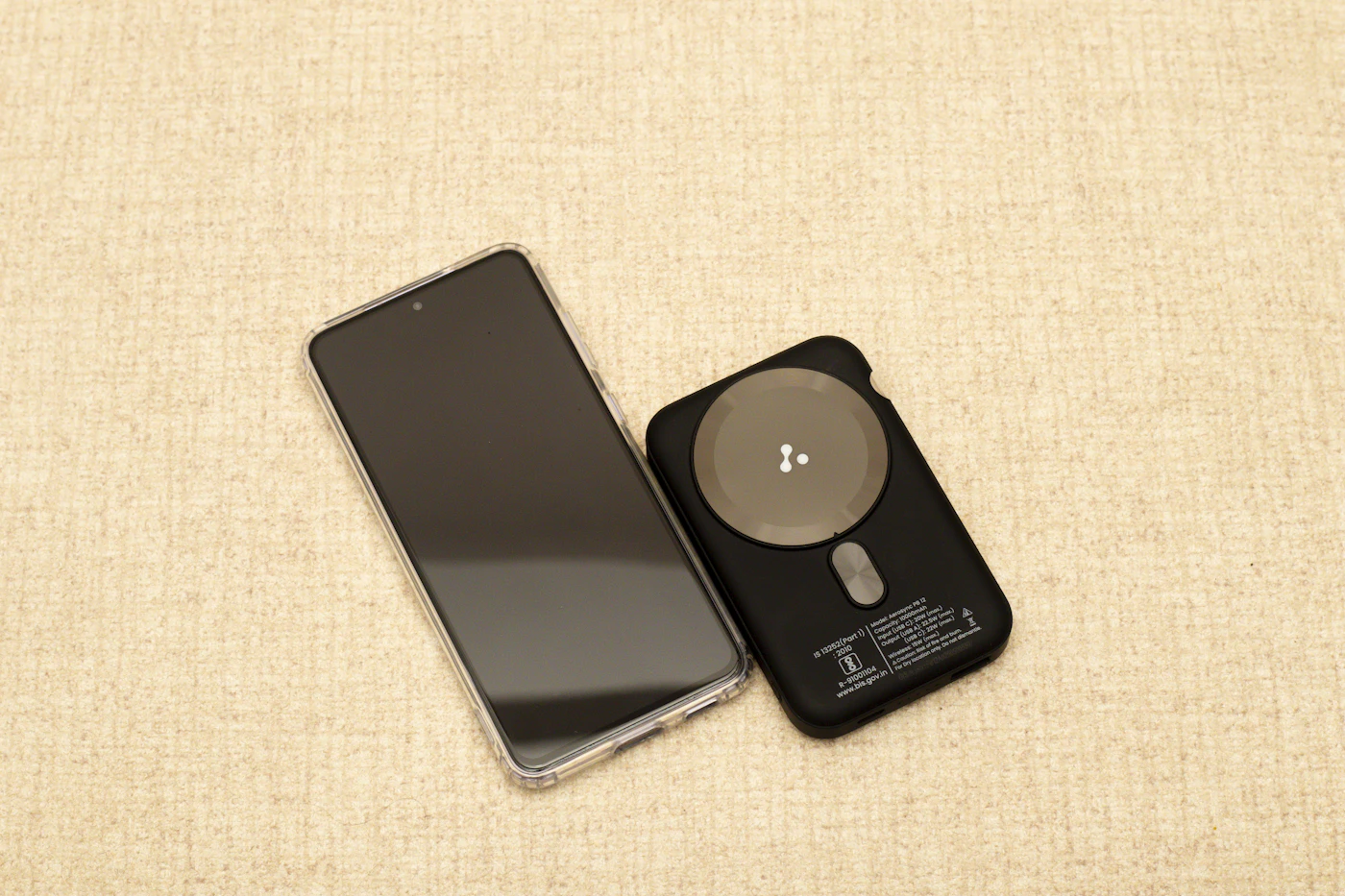
A magnetic design can reduce cable handling for compatible phones and cases, but it changes the phone's weight and grip. Verify the particular phone, case, attachment system, and charging standard rather than assuming that a magnetic fit guarantees the intended charging behavior. Think about photography, pockets, and how you hold the phone. If the extra bulk makes you remove the battery whenever you use it, a separate wired bank may better match your day.
Plan for recharging and storage
A power bank needs its own charging routine. Check its input requirements and whether your existing wall charger and cable are suitable. A large battery that is frequently left empty is less helpful than a smaller one that reliably returns to your bag charged. Keep the instructions available for any restrictions on simultaneous input and output.
Anker's official power-bank catalog provides examples of different form factors and use categories; compare the exact selected model rather than applying one product's claims to the entire range. Before flying, check current carrier and relevant authority rules for the specific battery, including labeling and baggage restrictions. For daily use, follow the manufacturer's storage guidance and stop using damaged equipment. A clearly documented product is easier to assess than an anonymous listing with an unusually impressive capacity claim.
A closer look at the tradeoffs
| Option | Best fit | Tradeoff |
|---|---|---|
| Compact wired bank | Daily phone top-ups | Cable must travel too |
| Compatible magnetic bank | Convenient phone attachment | Adds bulk directly to the phone |
| Laptop-capable bank | Work away from outlets | Larger size and strict output checks |
Before you buy
- Identify the actual charging gap.
- Check output as well as capacity.
- Verify phone and case compatibility.
- Plan how the bank itself gets charged.
Confirm the exact model, compatibility, current price, and return policy at the official destination before ordering.
Explore power banks at Anker ↗Common questions
How many times will it recharge my phone?
Do not infer an exact count from capacity alone. Look for measured results for the specific combination, and remember that using the phone while charging changes the outcome. A manufacturer's estimate is a comparison input, not a guaranteed result for your routine.
Can I bring it on a flight?
Check current rules with your airline and the relevant transport authority before travel. Requirements depend on the battery and itinerary. Use the product's labeled specifications, and do not assume that a retailer's travel-friendly description establishes permission for your flight.
Sources & further reading
Manufacturer documentation consulted October 10, 2026. Buying judgments are our editorial interpretation; published specifications do not establish real-world performance.
See something that needs updating? Send a correction.