Shopping links in this guide go to official brand pages and are not affiliate links. We do not earn a commission from them. Our disclosure
A home music setup should fit the room before it fills a shopping cart. The best choice for a studio apartment may be a single speaker with straightforward controls. A dedicated listening corner may justify a stereo pair, while a shared household may make headphones the most useful investment. Start with where you sit, when you listen, and who else uses the space. Those details narrow the decision far more effectively than a list of premium components.
Use one speaker for uncomplicated background music, consider a stereo pair for a consistent listening position, and choose headphones when personal listening matters most. Build one useful setup before expanding into several rooms.
Choose a listening place before choosing equipment
Draw a quick plan of the room with the sofa, desk, outlets, and available shelves. Mark where you actually spend time rather than where a speaker would look attractive in a product photograph. If you move between cooking and cleaning, coverage and easy control may matter more than a precise seated arrangement.
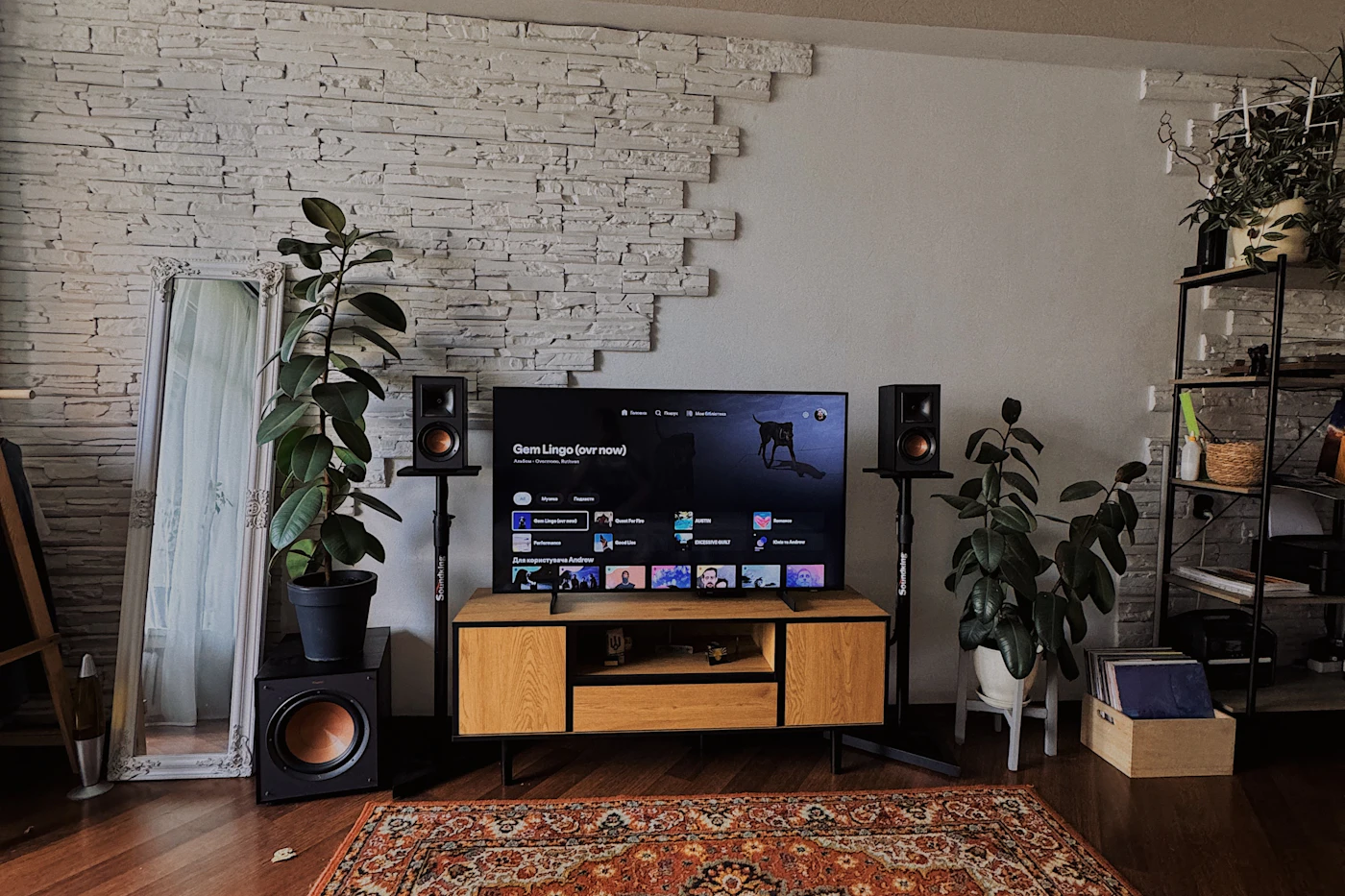
For focused listening, decide whether you can give two speakers sensible positions around the seat. If one must hide behind a plant and the other sits across a doorway, reconsider the layout before buying a pair. An achievable setup that stays in place is more useful than an ideal arrangement you dismantle after every session.
Distinguish a single-box system from a stereo project
A single wireless speaker keeps decisions and cables to a minimum. That can be exactly right for background playlists, radio, or a small room where music is one activity among several. The tradeoff is that it offers fewer placement options than two separate speakers arranged around a listening position.
A stereo pair introduces more physical commitments: two suitable locations, power or signal connections, and a stable arrangement. Treat those as part of the purchase price. If you cannot keep the positions consistent, do not assume buying two boxes automatically creates the listening experience you have in mind. Compare the whole arrangement, including furniture.
Make control simple for everyone who lives there
A speaker that only one person knows how to use can become an expensive decoration. Consider whether household members prefer a physical button, phone app, or another supported control method. Check what happens when the usual phone leaves home and whether another person can start playback without interrupting someone’s account.
Sonos maintains an official speaker catalog for comparing its home-audio range. When evaluating an ecosystem like this, examine the exact product’s setup requirements, supported services, and account dependencies before purchase. A broad product family is not evidence that every model supports every source or connection you want.
Budget for the things around the speaker
A shelf, stand, cable, or suitable adapter may be necessary to make the chosen product work in your room. Add those costs before comparing prices. It is easy to select a speaker within budget and then discover that the practical arrangement requires several additional purchases or a rearrangement you do not want.
Avoid buying future rooms in advance. Install one setup, live with its controls, and learn whether you enjoy the routine. Expansion is easier to judge after you know where listening actually happens. If the living-room speaker is rarely used, adding a bedroom model is unlikely to solve the underlying mismatch.
Know when headphones are the better home upgrade
If your main listening time overlaps with another person’s work or television, personal audio may solve the problem more cleanly. A comfortable headphone setup gives you a defined listening space without reorganizing shared furniture. Compare it against speakers as a genuine alternative, not merely as a temporary compromise.
Use familiar music to assess a purchase at the levels and positions you normally use. Avoid judging only during a brief, unusually loud demonstration. This is a buyer evaluation method, not a claim of testing by SmartGearScope. Keep the option that makes you start listening more often with fewer steps between the idea and the music.
A closer look at the tradeoffs
| Setup | Best fit | Tradeoff |
|---|---|---|
| Single wireless speaker | Simple background listening | Fewer placement possibilities |
| Stereo speaker pair | A consistent listening seat | Two positions and more setup effort |
| Headphones | Personal listening in shared spaces | One listener at a time |
Before you buy
- Sketch the room and listening positions.
- Check power and source connections.
- Include stands and accessories in the budget.
- Confirm other household members can start playback.
Confirm the exact model, compatibility, current price, and return policy at the official destination before ordering.
Explore home speakers at Sonos’s official store ↗Common questions
Do I need a multiroom system from the beginning?
No. Start with the room where you listen most. Expand only after the controls and supported services fit your household and another room has a clear purpose.
Should I buy a speaker before choosing its location?
Choose at least a realistic location first. Available space, outlets, furniture, and your listening position can rule out an otherwise appealing product.
Sources & further reading
Manufacturer documentation consulted October 10, 2026. Buying judgments are our editorial interpretation; published specifications do not establish real-world performance.
See something that needs updating? Send a correction.